Arterial stiffness is increasingly recognized as an important factor in cardiovascular health. As blood vessels lose elasticity over time due to aging or disease, their ability to buffer the pulsatile flow generated by the heart decreases. One of the most established parameters for assessing this change is pulse wave velocity (PWV).
Pulse wave velocity describes the speed at which the pressure wave travels along the arteries. In healthy, elastic vessels, this wave moves relatively slowly. However, as arterial walls become stiffer, the velocity increases. For this reason, PWV is considered a reliable, non-invasive marker for vascular aging and cardiovascular risk.
Understanding Pulse Wave Velocity
When the heart contracts, it generates a pressure wave that propagates through the arterial system. The speed of this wave depends on the elasticity of the vessel walls.
In compliant arteries, part of the energy is absorbed by the vessel wall, resulting in a slower wave propagation. In contrast, stiff arteries transmit the wave more rapidly, leading to higher PWV values.
This relationship makes PWV a direct indicator of arterial stiffness and an important parameter in vascular assessment.
How Is Pulse Wave Velocity Measured?
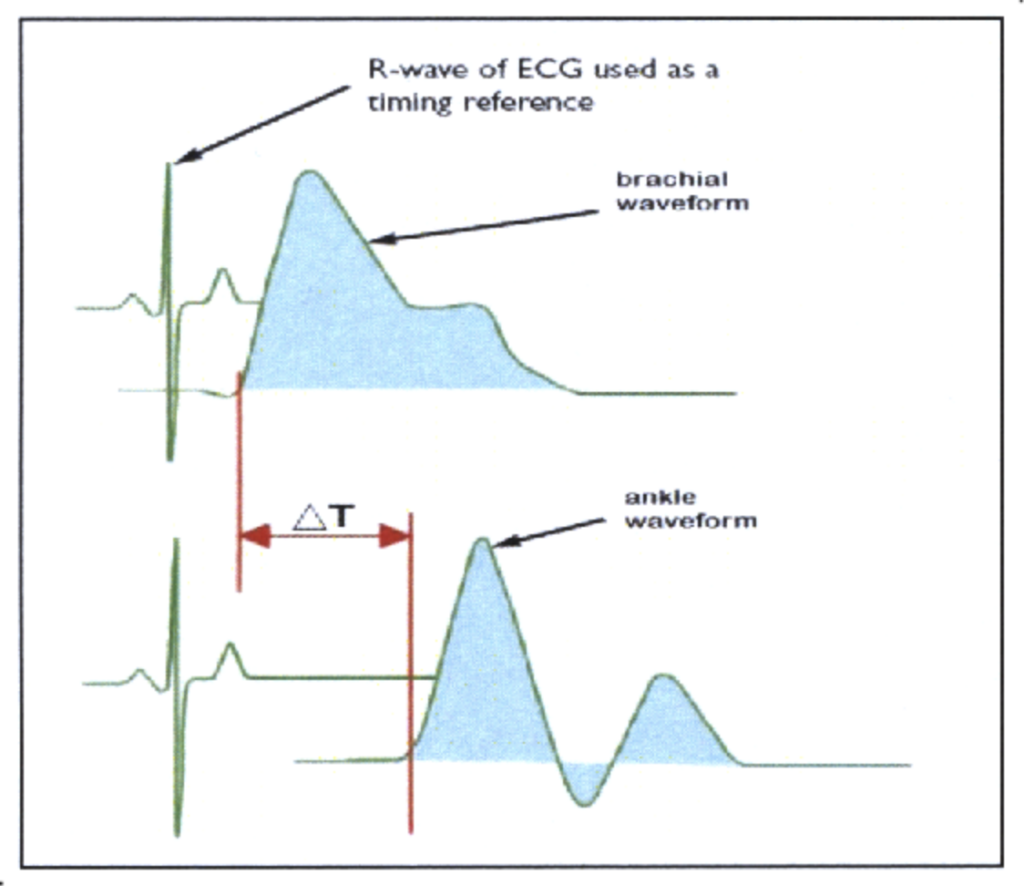
Pulse wave velocity is calculated by measuring how fast the pressure wave travels between two points in the arterial system. In practice, this is done by recording the time it takes for the pulse wave to move from a proximal to a distal measurement site.
The formula is simple:
PWV = distance / transit time
The distance between the two measurement points (e.g. carotid to femoral artery) is divided by the time it takes for the pulse wave to travel this path. As arterial stiffness increases, the pulse wave travels faster, resulting in higher PWV values. This straightforward principle allows clinicians to quantify arterial stiffness in a non-invasive and reproducible way.
Clinical Relevance of Arterial Stiffness
Increased arterial stiffness is associated with a higher risk of cardiovascular events, including hypertension, stroke and heart disease. It also reflects cumulative vascular damage caused by factors such as aging, diabetes, smoking and metabolic disorders.
Importantly, arterial stiffness can develop long before clinical symptoms appear. This makes PWV a valuable tool for early detection and risk stratification, particularly in patients with known cardiovascular risk factors.
Despite this, PWV is still not consistently integrated into routine clinical practice, where traditional parameters such as blood pressure or ABI are more commonly used.
PWV in Modern Vascular Diagnostics
Integrating pulse wave velocity into vascular diagnostics allows for a more comprehensive assessment of arterial function. While measurements such as ABI focus on detecting arterial obstruction, PWV provides additional information about the condition of the vessel wall itself.
This combination of structural and functional insight supports a more complete understanding of vascular health.
In preventive care, PWV can help identify early vascular changes, enabling timely intervention. In clinical settings, it may contribute to improved risk assessment and monitoring of disease progression.
Expanding Awareness in Clinical Practice
Although the scientific relevance of PWV is well established, awareness in everyday clinical practice remains limited. Increasing familiarity with this parameter can help clinicians better interpret vascular health and incorporate arterial stiffness into their diagnostic considerations.
As healthcare continues to move toward prevention and early detection, parameters such as PWV are likely to gain importance in routine assessments.
Integrated Vascular Assessment
A comprehensive evaluation of vascular health benefits from combining different diagnostic parameters. Systems such as AngE™ ABI+ enable structured, non-invasive assessment of arterial circulation and vascular function within a single workflow.
By integrating multiple measurements, clinicians can gain a broader and more detailed understanding of vascular status.
👉 Learn More: https://www.sot-medical.com/solutions/
Conclusion
Pulse wave velocity is a powerful yet underutilized parameter in vascular diagnostics. As a direct indicator of arterial stiffness, it provides valuable insight into vascular aging and cardiovascular risk.
Integrating PWV into clinical practice can support earlier detection, improve risk assessment and contribute to more comprehensive vascular care.
Sources:
https://www.eshonline.org/annual-meeting-posts/measurement-of-aortic-stiffness/
https://pmc.ncbi.nlm.nih.gov/articles/PMC11317333/